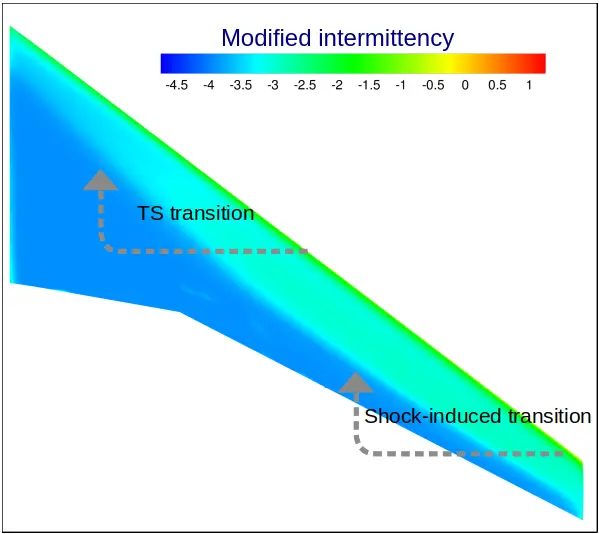

The ability to model transition to turbulence is important when performing computational fluid dynamics (CFD) simulations for aircraft configurations.
The design of low-drag, laminar flow airfreams depends on the inclusion of such effects in the CFD simulations.
Additionally, wings that are not designed to sustain laminar flow may present laminar boundary layers in some flight conditions, two examples being the low-Reynolds number flow over high-lift devices and the cruise configuration wings of regional jetliners.
Transition prediction is also relevant in propeller flows, in which shear-driven crossflow (CF) modes can trigger transition to turbulence. However, despite the relevance of accounting for transition to turbulence prediction in CFD simulations, practitioners still miss robust, optimization-compatible tools that are able to consider this phenomenon.